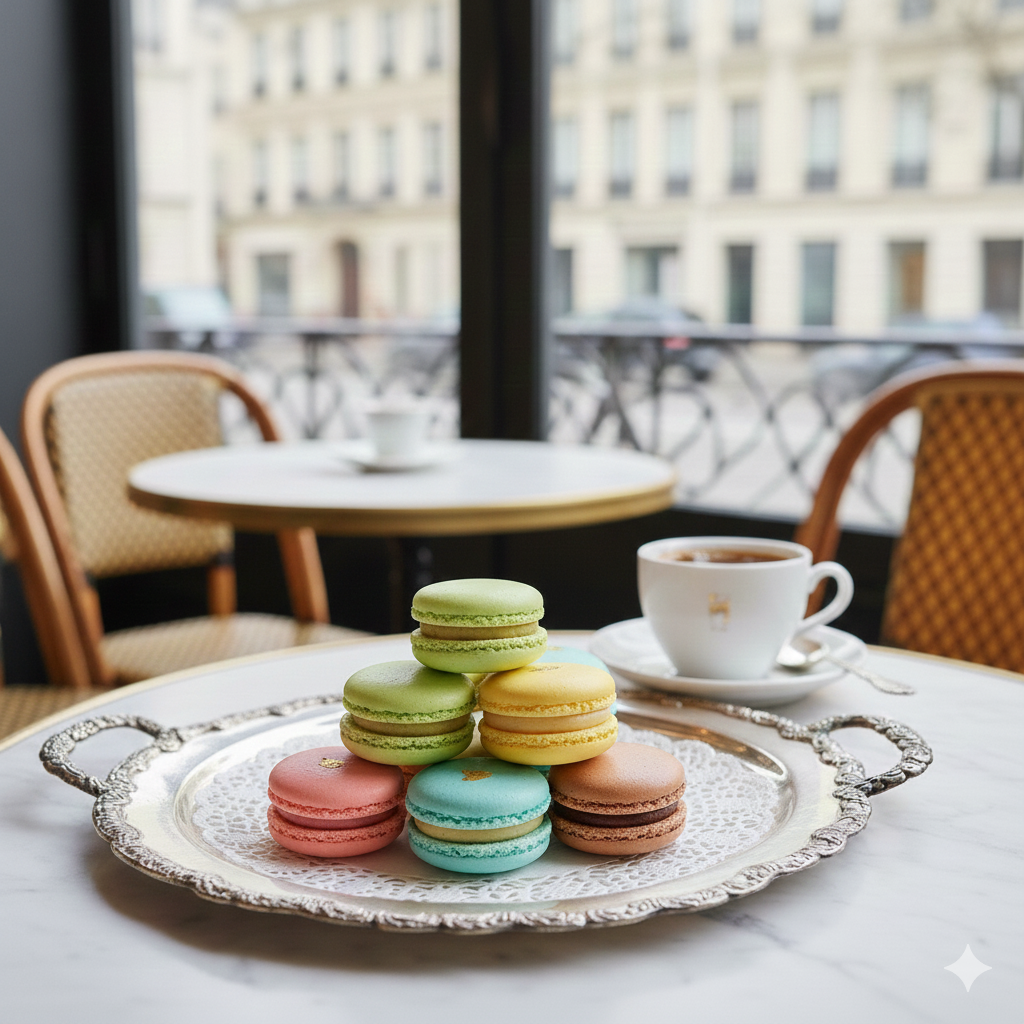
A good Paris macaron is all about contrast and precision: a thin, delicate shell that gives a soft “crack”, a moist, fondant interior, and a filling that tastes clearly of what it claims to be — pistachio that really tastes of nuts, raspberry that tastes of fruit rather than perfume. The best versions are not neon-bright sugar bombs, but quietly elegant, with natural colours and balanced flavours.
This page gathers some of the best macarons in Paris today — from big-name houses to more discreet pastry shops — so you can spend your time tasting instead of wandering from pastel box to pastel box, wondering which one is really worth it.
The macarons you shouldn’t miss
Pierre Hermé – Saint-Germain (6ᵉ arrondissement)
Pierre Hermé is often called the “Picasso of pastry”, and his macarons show why. Classic flavours like vanilla or pistachio sit next to bolder creations such as Ispahan (rose, lychee, raspberry) and Mogador (milk chocolate and passion fruit), with textures that are usually spot on: crisp shell, melting interior and vivid, layered fillings.
- Address: 72 rue Bonaparte, 75006 Paris
- Nearest métro: Saint-Germain-des-Prés (Line 4) or Saint-Sulpice (Line 4)
- Macaron style: inventive, intense flavours with seasonal collections alongside “Incontournables” like Ispahan and Infiniment Vanille
- Good for: a first “wow” box of macarons or a tasting stop during a Saint-Germain wander
Ladurée – Rue Royale (8ᵉ arrondissement)
Ladurée is the historic name most visitors know – and the original Rue Royale boutique, opened in 1862, is still one of the prettiest spots to buy macarons in Paris. Expect a very classic style: pastel boxes, smooth shells, and familiar flavours like salted caramel, pistachio and raspberry, all with a soft, sweet interior.
- Address: 16 rue Royale, 75008 Paris
- Nearest métro: Concorde (Lines 1, 8, 12) or Madeleine (Lines 8, 12, 14)
- Macaron style: elegant, classic French flavours, more on the sweet side than some artisan houses
- Good for: a very Parisian tea-salon feel, gift boxes to bring home, or a first macaron experience
Carette – Trocadéro (16ᵉ arrondissement)
At Carette, the experience is as important as the macarons themselves. This historic tea room on Place du Trocadéro looks straight towards the Eiffel Tower and has been a rendez-vous for elegant Parisians since the 1920s. The macarons skew classic – pistachio, chocolate, raspberry – with a light, crisp shell and a generous, creamy filling.
- Address: 4 place du Trocadéro, 75016 Paris
- Nearest métro: Trocadéro (Lines 6, 9)
- Macaron style: traditional flavours, slightly rustic look, very Parisian tea-room vibe
- Good for: combining macarons with hot chocolate or tea before or after an Eiffel Tower visit
Sadaharu Aoki – Vaugirard (6ᵉ arrondissement)
Sadaharu Aoki brings a Japanese point of view to French pastry, and his macarons reflect that: matcha, black sesame, yuzu or genmaicha sit next to more familiar flavours, all extremely precise and not overly sweet. If you like green tea or citrus, this is one of the most interesting macaron stops in Paris.
- Address: 35 rue de Vaugirard, 75006 Paris
- Nearest métro: Saint-Placide (Line 4) or Rennes (Line 12)
- Macaron style: clean flavours, often tea-based; a little less sweet, with very neat shells
- Good for: anyone who loves matcha, Japanese flavours, or wants something less conventional than Ladurée
Carl Marletti – 5ᵉ arrondissement
On a quiet street in the Latin Quarter, Carl Marletti is more of a pâtisserie than a pure macaron house, but his macarons are a lovely surprise: compact, with a smooth shell and ganache-based fillings that highlight fruit or chocolate without being heavy. It’s a great excuse to explore a more local part of the 5ᵉ.
Good for: combining macarons with classic French cakes on the same tray, especially if you’re staying near the Latin Quarter
Address: 51 rue Censier, 75005 Paris
Nearest métro: Censier-Daubenton (Line 7)
Macaron style: small, polished macarons with clear flavours and a pâtissier’s touch
Tours & classes to go deeper
If you’d like to go beyond simply tasting macarons and actually learn how to make them, Paris has some excellent small-group pastry classes. Most are taught in English, and you leave with your own box of macarons (plus a much better understanding of what can go wrong at home).
French pastry class with a chef (macarons, croissants or tarts)
This 2.5–3 hour hands-on class in central Paris lets you choose between macarons, croissants or another French pastry. You work in a small group with a French chef, learn each step of the recipe, and leave with a box of your own creations to eat or take home.
Explore the finest Macarons in Paris.
To savor the best macarons in Paris, it’s crucial to stop by these bakeries that have become well-known landmarks.
More excellent macarons to try
Pierre Marcolini – 6ᵉ
89 rue de Seine, 75006 Paris
A Belgian chocolatier with a refined Paris boutique in Saint-Germain. The macarons lean towards chocolate and praline, with precise shells and rich ganaches – ideal if you love cocoa-forward flavours.
La Maison du Chocolat – François-1er, 8ᵉ
52 rue François 1er, 75008 Paris
Primarily known for high-end chocolates, this house also makes very polished macarons with ultra-smooth ganaches and a strong chocolate identity. It’s a great stop if you’re already exploring Avenue Montaigne or the “triangle d’or”.
Jean-Paul Hévin – Vendôme / Louvre, 1ᵉʳ
231 rue Saint-Honoré (courtyard), 75001 Paris
A reference for serious chocolate, and that expertise shows in the macarons. Many flavours are chocolate-based with subtle twists (single-origin cacao, caramel, fruit). If you prefer deeper, less sugary profiles, this is a strong choice.
Angelina – Rivoli, 1ᵉʳ
226 rue de Rivoli, 75001 Paris
Angelina is famous for hot chocolate and the Mont-Blanc dessert, but their macarons are a pleasant bonus: classic flavours in a Belle Époque tea-room setting directly across from the Tuileries Gardens. Expect a slightly more touristy vibe, but it’s hard to beat the atmosphere.
Macaron FAQ for Paris visitors
How much does a good macaron cost in Paris?
In most quality pâtisseries, a single macaron costs roughly 1.80€ to 3.50€, depending on the house and the neighbourhood. Big luxury names and tea rooms tend to sit at the upper end of that range, while smaller artisan shops can still feel more reasonable. Guides that track Paris prices generally quote around 2.50€ per macaron on average in high-end boutiques.
If you’re on a budget, buying a small box rather than individual pieces is often slightly better value – and easier to carry around without crushing them.
Where is it better to buy macarons: in pâtisseries or tourist stands?
For the best experience, buy macarons in serious pâtisseries or chocolatier-pâtissiers that make them on site or in a central lab. Houses like Pierre Hermé, Ladurée, Sadaharu Aoki, Jean-Paul Hévin, La Maison du Chocolat or Carl Marletti have a clear reputation and strong quality control.
Cheaper stands in ultra-touristy areas sometimes sell very sweet, dry, over-coloured macarons that look good on Instagram but taste disappointing. If you’re unsure, buy one macaron as a test before committing to a big box.
How long do macarons keep? Can I bring them home?
Most Paris boutiques recommend eating macarons within 2–3 days, stored in the fridge in their original box and brought back to room temperature before eating. The texture is best on day one and two; after that, shells can dry out or fillings can soften too much.
To bring macarons home:
- Ask for a rigid box rather than a loose bag
- Keep the box flat in your hand luggage, not in a checked suitcase
- Avoid big temperature changes if possible
Many travellers safely bring boxes back on flights — just remember that the goal is to enjoy them shortly after you land, not to keep them for weeks.
What time of day is best to buy macarons?
Macarons don’t depend on “fresh from the oven” in the same way as croissants, but they still have a rhythm:
- Many shops start the day with a full display and top condition
- Late evenings in very busy areas can mean fewer flavours left
If you want the best selection and texture, late morning to mid-afternoon is usually ideal. On hot summer days, it’s safer not to carry them around for hours in the sun.